The Sun
The Sun is a yellow dwarf star (G2V), about 4.6 billion years old, and the dominant gravitational force in the Solar System. It has a diameter of roughly 1.4 million kilometers and contains around 99.8% of the Solar System’s mass. Nuclear fusion in its core converts hydrogen into helium, producing energy that warms the planets. Above the core lie the radiative and convective zones, followed by the visible photosphere (~5,500 °C), the chromosphere, and the much hotter corona (~2 million °C).
Source: science.nasa.gov
APODs including "The Sun"
Meteors Now and Again
10/08/1998
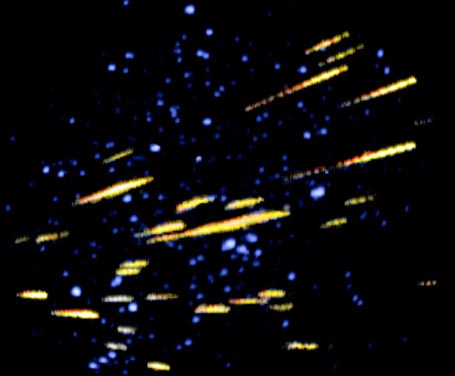
The Perseid Meteor Shower, usually the best meteor shower of the year, will peak over the next two nights. Over the course of an hour, a person watching a clear sky from a dark location might see as many as 100 meteors. These meteors are actually specs of rock that have broken off Comet Swift-Tuttle and continue to orbit the Sun. This year, however, the Perseids may only be second best. In November the Earth is predicted to move through a denser stream of Comet Tempel-Tuttle debris, possibly causing greater than 10,000 meteors per hour visible at some locations. Pictured above is the alpha-Monocerotid meteor outburst of 1995. This is the last week to send your name to a comet with NASA's planned Stardust mission.