The Sun
The Sun is a yellow dwarf star (G2V), about 4.6 billion years old, and the dominant gravitational force in the Solar System. It has a diameter of roughly 1.4 million kilometers and contains around 99.8% of the Solar System’s mass. Nuclear fusion in its core converts hydrogen into helium, producing energy that warms the planets. Above the core lie the radiative and convective zones, followed by the visible photosphere (~5,500 °C), the chromosphere, and the much hotter corona (~2 million °C).
Source: science.nasa.gov
APODs including "The Sun"
Sun Dance
11/08/1998
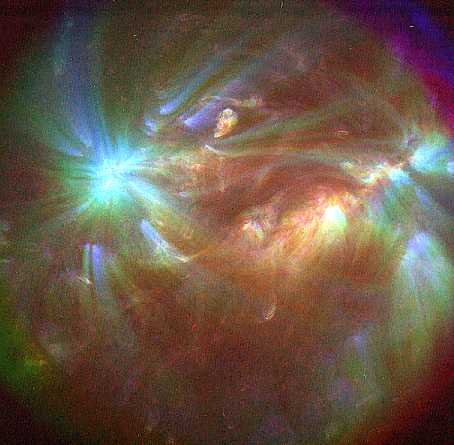
Hot gas dances across the surface of the Sun in this picture from the orbiting TRACE satellite. The temperature of the gas is color coded so that blue represents hundreds of thousands of Kelvin, while red represents extreme temperatures in the millions of Kelvin. Hot gas is channeled into lanes ordered by the Sun's chaotic magnetic field. Pictures like these have shown that plasma heating occurs in relatively small regions.