The Sun
The Sun is a yellow dwarf star (G2V), about 4.6 billion years old, and the dominant gravitational force in the Solar System. It has a diameter of roughly 1.4 million kilometers and contains around 99.8% of the Solar System’s mass. Nuclear fusion in its core converts hydrogen into helium, producing energy that warms the planets. Above the core lie the radiative and convective zones, followed by the visible photosphere (~5,500 °C), the chromosphere, and the much hotter corona (~2 million °C).
Source: science.nasa.gov
APODs including "The Sun"
The Sun Erupts
30/08/1998
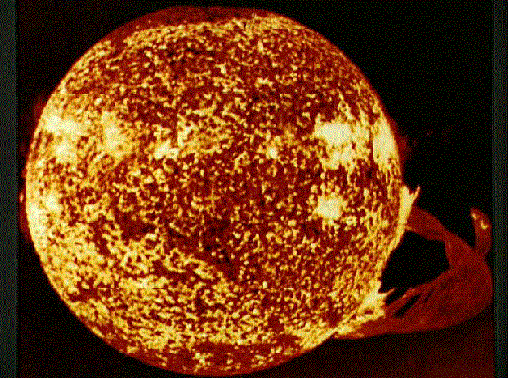
The Sun is a seething ball of extremely hot gas. Above, the Sun was captured by Skylab in 1973 throwing off one the largest eruptive prominences in recorded history. The Sun has survived for about 5 billion years, and will likely survive for another 5 billion. The Sun is not on fire, will never explode, and a solar flare will never destroy the Earth. The Sun continues to present many unanswered questions. For example: Why is the Sun's corona so hot? What causes the Sun's unusual magnetic field? Why does the Sun's center emit so few neutrinos?