The Sun
The Sun is a yellow dwarf star (G2V), about 4.6 billion years old, and the dominant gravitational force in the Solar System. It has a diameter of roughly 1.4 million kilometers and contains around 99.8% of the Solar System’s mass. Nuclear fusion in its core converts hydrogen into helium, producing energy that warms the planets. Above the core lie the radiative and convective zones, followed by the visible photosphere (~5,500 °C), the chromosphere, and the much hotter corona (~2 million °C).
Source: science.nasa.gov
APODs including "The Sun"
Mariner's Mercury
06/09/1998
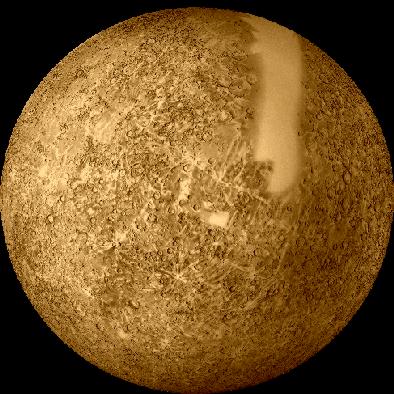
Mercury, the closest planet to the Sun, remains the most mysterious of the Solar System's inner planets. Hiding in the Sun's glare it is a difficult target for Earth bound observers. The only spacecraft to explore Mercury close-up was Mariner 10 which executed 3 flybys of Mercury in 1974 and 1975, surveying approximately 45 percent of its surface. Mariner 10 deftly manuevered to photograph part of the sunlit hemisphere during each approach, passed behind the planet, and continued to image the sun-facing side as the spacecraft receded. Its highest resolution photographs recorded features approximately a mile across. A recent reprocessing of the Mariner 10 data has resulted in this dramatic mosaic. Like the Earth's Moon, Mercury's surface shows the scars of impact cratering - the smooth vertical band and patches visible above represent regions where no image information is available.