The Sun
The Sun is a yellow dwarf star (G2V), about 4.6 billion years old, and the dominant gravitational force in the Solar System. It has a diameter of roughly 1.4 million kilometers and contains around 99.8% of the Solar System’s mass. Nuclear fusion in its core converts hydrogen into helium, producing energy that warms the planets. Above the core lie the radiative and convective zones, followed by the visible photosphere (~5,500 °C), the chromosphere, and the much hotter corona (~2 million °C).
Source: science.nasa.gov
APODs including "The Sun"
Comet Williams in 1998
06/10/1998
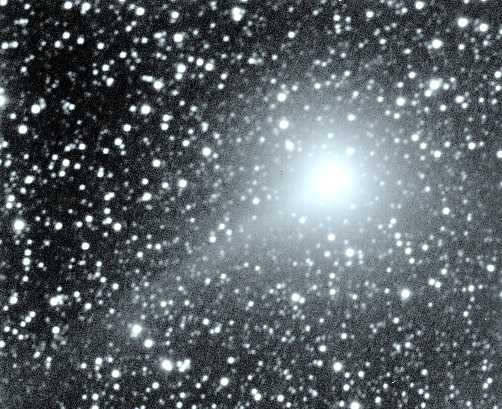
The brightest comet in the sky right now is Comet Williams. Moving slowly though the constellation of Centaurus, Comet Williams, at magnitude 8, is visible to Southern Hemisphere observers with binoculars. In ten days, Comet Williams will reach its closest point to the Sun, although it will still be farther from the Sun than the Earth. Comet Williams should become visible to many Northern Hemisphere observers in late November. At magnitude 10, however, it might require a small telescope to see. Comet Williams was discovered in early August by Peter Williams. The above image was taken August 25th from Australia.