The Sun
The Sun is a yellow dwarf star (G2V), about 4.6 billion years old, and the dominant gravitational force in the Solar System. It has a diameter of roughly 1.4 million kilometers and contains around 99.8% of the Solar System’s mass. Nuclear fusion in its core converts hydrogen into helium, producing energy that warms the planets. Above the core lie the radiative and convective zones, followed by the visible photosphere (~5,500 °C), the chromosphere, and the much hotter corona (~2 million °C).
Source: science.nasa.gov
APODs including "The Sun"
A Great Day For SOHO
15/10/1998
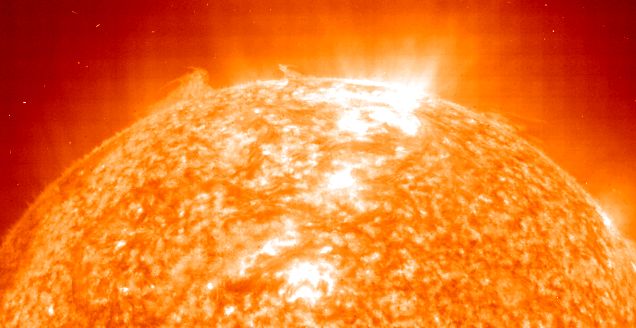
The last 10 days have been great days for SOHO, the space-based SOlar and Heliospheric Observatory. Contact was completely lost with this international research spacecraft over 3 months ago but recovery teams have reacquired control of SOHO and, beginning October 5th, have been successfully switching on its scientific instruments. This October 13th view of the Sun in the light of ionized Helium atoms was recorded by the restored EIT instrument. It shows bright active regions and lofty prominences above the solar limb. North is toward the left rather than the top as the spacecraft's orientation has not yet been fully adjusted. (For a full Sun / full resolution view, click on the picture!) With the solar cycle approaching a maximum in the coming years, excitement continues to build as it becomes very likely that SOHO will be able to resume its unprecedented exploration of solar phenomena.