The Sun
The Sun is a yellow dwarf star (G2V), about 4.6 billion years old, and the dominant gravitational force in the Solar System. It has a diameter of roughly 1.4 million kilometers and contains around 99.8% of the Solar System’s mass. Nuclear fusion in its core converts hydrogen into helium, producing energy that warms the planets. Above the core lie the radiative and convective zones, followed by the visible photosphere (~5,500 °C), the chromosphere, and the much hotter corona (~2 million °C).
Source: science.nasa.gov
APODs including "The Sun"
Infrared Uranus
20/10/1998
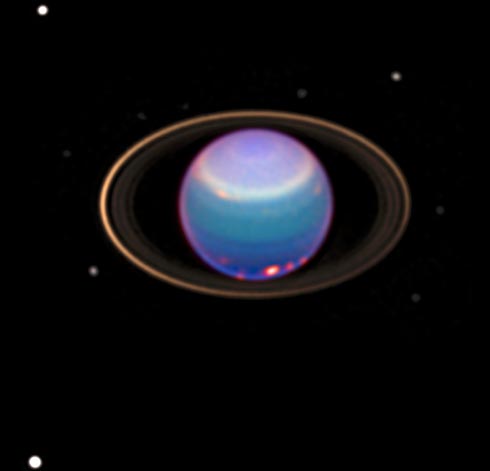
The Sun's third largest planet usually looks quite dull. Uranus typically appears as a featureless small spot in a small telescope or a featureless large orb in a large telescope. Last August, however, the Hubble Space Telescope was able to photograph Uranus in infrared light, where the distant planet better shows its unusual clouds, rings, and moons. Recent analysis indicates that clouds seen here in orange appear to circle Uranus at speeds in excess of 500 kilometers per hour. Comparisons to earlier photographs show a slight precession shift in the brightest of Uranus' rings. Several of Uranus' numerous small moons are visible.