The Sun
The Sun is a yellow dwarf star (G2V), about 4.6 billion years old, and the dominant gravitational force in the Solar System. It has a diameter of roughly 1.4 million kilometers and contains around 99.8% of the Solar System’s mass. Nuclear fusion in its core converts hydrogen into helium, producing energy that warms the planets. Above the core lie the radiative and convective zones, followed by the visible photosphere (~5,500 °C), the chromosphere, and the much hotter corona (~2 million °C).
Source: science.nasa.gov
APODs including "The Sun"
Natural Saturn On The Cassini Cruise
05/11/1998
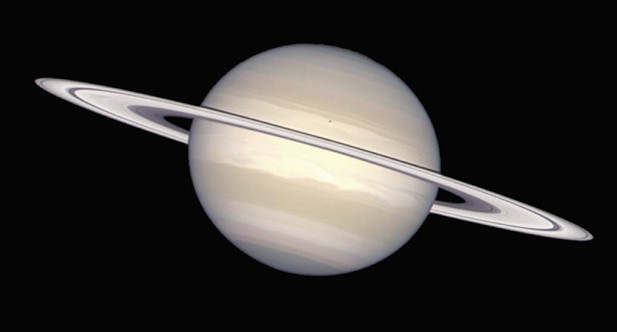
What you could see approaching Saturn aboard an interplanetary cruise ship would closely resemble this subtly shaded view of the gorgeous ringed gas giant. Processed by the Hubble Heritage project, the picture intentionally avoids overemphasizing color contrasts and presents a natural looking Saturn with cloud bands, storms, nearly edge-on rings, and the small round shadow of the moon Enceladus near the center of the planet's disk. Of course, seats were not available on the only ship currently enroute - the Cassini spacecraft, launched just over a year ago and scheduled to arrive at Saturn in the year 2004. After an extended cruise to a world 1,400 million kilometers from the Sun, Cassini will tour the Saturnian system, conducting a remote, robotic exploration with software and instruments designed by denizens of planet Earth.