The Sun
The Sun is a yellow dwarf star (G2V), about 4.6 billion years old, and the dominant gravitational force in the Solar System. It has a diameter of roughly 1.4 million kilometers and contains around 99.8% of the Solar System’s mass. Nuclear fusion in its core converts hydrogen into helium, producing energy that warms the planets. Above the core lie the radiative and convective zones, followed by the visible photosphere (~5,500 °C), the chromosphere, and the much hotter corona (~2 million °C).
Source: science.nasa.gov
APODs including "The Sun"
Leonid Meteor Shower Next Week
08/11/1998
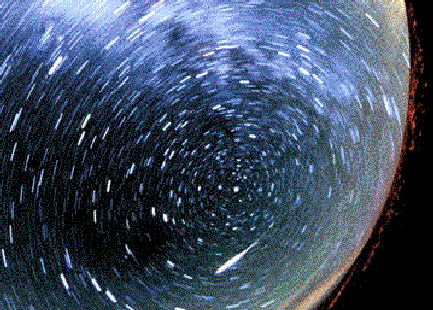
rly next week, a spectacular meteor storm is expected: the 1998 Leonids. It is widely thought that that the meteors from the Leonids meteor shower are just small pieces of Comet Temple-Tuttle falling to Earth. During each pass near the Sun, a comet will heat up and shed pieces of ice and rock from its nucleus. This debris continues to orbit the Sun until either evaporating or being swept up by some large solar-system body. A piece of comet debris striking the Moon creates a small crater, but a piece striking the Earth usually burns up in the atmosphere causing a brief, bright streak. The streak below center in the above picture of the northern sky actually depicts a meteor from the Perseid meteor shower, a usually impressive display that peaks every year in mid-August.