The Sun
The Sun is a yellow dwarf star (G2V), about 4.6 billion years old, and the dominant gravitational force in the Solar System. It has a diameter of roughly 1.4 million kilometers and contains around 99.8% of the Solar System’s mass. Nuclear fusion in its core converts hydrogen into helium, producing energy that warms the planets. Above the core lie the radiative and convective zones, followed by the visible photosphere (~5,500 °C), the chromosphere, and the much hotter corona (~2 million °C).
Source: science.nasa.gov
APODs including "The Sun"
Driving To The Sun
12/12/1998
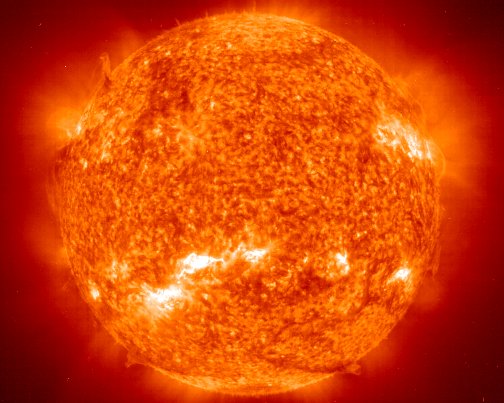
How long would it take to drive to the Sun? Brittany, age 7, and D.J., age 12, ponder this question over dinner one evening. James, also age 7, suggests taking a really fast racing car while Christopher, age 4, eagerly agrees. Jerry, a really old guy who is used to estimating driving time on family trips based on distance divided by speed, offers to do the numbers. "Let's see ... the Sun is 93 million miles away. So, if we drove 93 miles per hour the trip would only take us 1 million hours." How long is 1 million hours? One year is 365 days times 24 hours per day, or 8,760 hours. One hundred years would be 876,000 hours, still a little short of the 1 million hour drive time -- so the Sun is really quite far away. Christopher is not impressed, but as he grows older he will be. You've got to be impressed by something that's 93 million miles away and still hurts your eyes when you look at it!