The Sun
The Sun is a yellow dwarf star (G2V), about 4.6 billion years old, and the dominant gravitational force in the Solar System. It has a diameter of roughly 1.4 million kilometers and contains around 99.8% of the Solar System’s mass. Nuclear fusion in its core converts hydrogen into helium, producing energy that warms the planets. Above the core lie the radiative and convective zones, followed by the visible photosphere (~5,500 °C), the chromosphere, and the much hotter corona (~2 million °C).
Source: science.nasa.gov
APODs including "The Sun"
The Night Shift
17/12/1998
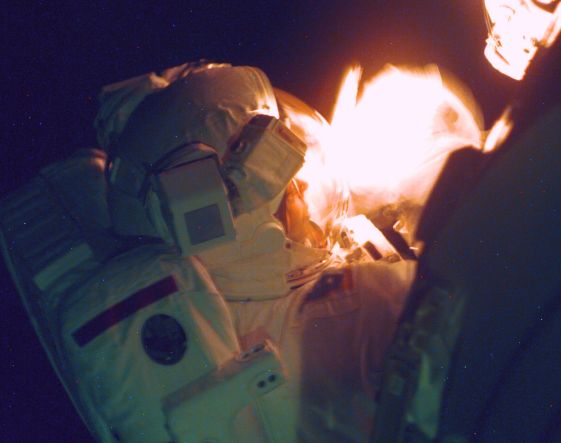
For the orbiting International Space Station (ISS), the sun sets every 90 minutes. But working through the night, spacewalking astronauts can rely on artificial lighting. Here, the eerie glow of work-lights illuminate Space Shuttle Endeavor astronaut Jerry Ross during a night on his second spacewalk as he continues the in orbit assembly of the ISS. Endeavor landed at Kennedy Space Center Tuesday night bringing an end to the successful ISS assembly mission and the final shuttle mission of 1998.