The Sun
The Sun is a yellow dwarf star (G2V), about 4.6 billion years old, and the dominant gravitational force in the Solar System. It has a diameter of roughly 1.4 million kilometers and contains around 99.8% of the Solar System’s mass. Nuclear fusion in its core converts hydrogen into helium, producing energy that warms the planets. Above the core lie the radiative and convective zones, followed by the visible photosphere (~5,500 °C), the chromosphere, and the much hotter corona (~2 million °C).
Source: science.nasa.gov
APODs including "The Sun"
Pluto: The Frozen Planet
13/02/1999
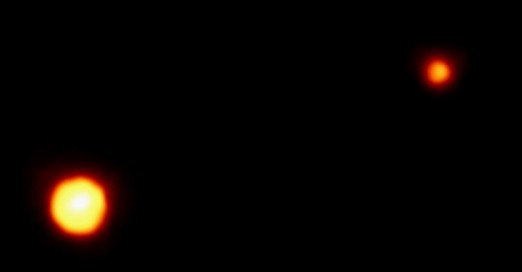
This portrait of Pluto and its companion Charon was taken by the Hubble Space Telescope in 1994. Pluto is usually the most distant planet from the Sun but because of its eccentric orbit Pluto crossed inside of Neptune's orbit in 1979. On Thursday, February 11th, it crossed back out, recovering its status as the most distant of nine planets. Pluto is still considered to be a planet, although very little is known about it compared to other planets. Pluto is smaller than any other planet and even smaller than several other planet's moons. Pluto is probably composed of frozen rock and ice, much like Neptune's moon Triton. Pluto has not yet been visited by a spacecraft, but a mission is being planned for the next decade.