The Sun
The Sun is a yellow dwarf star (G2V), about 4.6 billion years old, and the dominant gravitational force in the Solar System. It has a diameter of roughly 1.4 million kilometers and contains around 99.8% of the Solar System’s mass. Nuclear fusion in its core converts hydrogen into helium, producing energy that warms the planets. Above the core lie the radiative and convective zones, followed by the visible photosphere (~5,500 °C), the chromosphere, and the much hotter corona (~2 million °C).
Source: science.nasa.gov
APODs including "The Sun"
Dark Sky, Bright Sun
14/02/1999
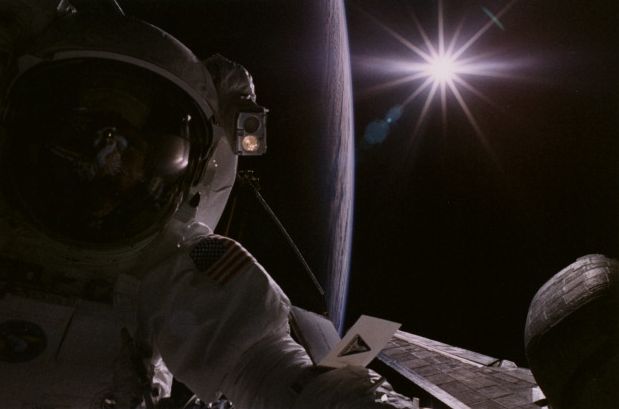
In low Earth orbit there is not enough atmosphere to diffuse and scatter sunlight, so shadows are black and the sky is dark - even when the Sun shines. The harsh lighting produced this dramatic effect as mission specialist Gregory Harbaugh photographed colleague Joseph Tanner during their second spacewalk to service the Hubble Space Telescope in February 1997. The aft section of the Space Shuttle Discovery is visible in the background with the Sun hanging over a delicate crescent of the Earth's limb. A checklist is attached to Tanner's left arm, and Harbaugh's reflection is just visible in Tanner's visor.