The Sun
The Sun is a yellow dwarf star (G2V), about 4.6 billion years old, and the dominant gravitational force in the Solar System. It has a diameter of roughly 1.4 million kilometers and contains around 99.8% of the Solar System’s mass. Nuclear fusion in its core converts hydrogen into helium, producing energy that warms the planets. Above the core lie the radiative and convective zones, followed by the visible photosphere (~5,500 °C), the chromosphere, and the much hotter corona (~2 million °C).
Source: science.nasa.gov
APODs including "The Sun"
March of the Planets
25/03/1999
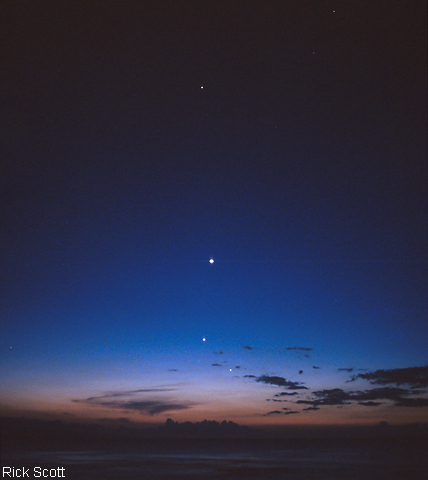
This March stargazers have been treated to eye-catching formations of bright planets in western evening skies. On March 3rd, looking toward a beautiful sunset from a beach on the Hawaiian isle of Maui, photographer Rick Scott recorded this fleeting, four-planet "hockey stick" array. Mercury, closest to the horizon and immersed in fading sunlight, is easily visible between silhouetted clouds. To the left and up in the deepening blue is Jupiter with a brilliant Venus above and Saturn shining in the darkened sky near the top of the image. The planets are seen to lie close to the ecliptic - the apparent path of the sun - which is nearly perpendicular to the horizon for Hawaiian latitudes at this time of year.