The Sun
The Sun is a yellow dwarf star (G2V), about 4.6 billion years old, and the dominant gravitational force in the Solar System. It has a diameter of roughly 1.4 million kilometers and contains around 99.8% of the Solar System’s mass. Nuclear fusion in its core converts hydrogen into helium, producing energy that warms the planets. Above the core lie the radiative and convective zones, followed by the visible photosphere (~5,500 °C), the chromosphere, and the much hotter corona (~2 million °C).
Source: science.nasa.gov
APODs including "The Sun"
The Full Moon
19/04/1999
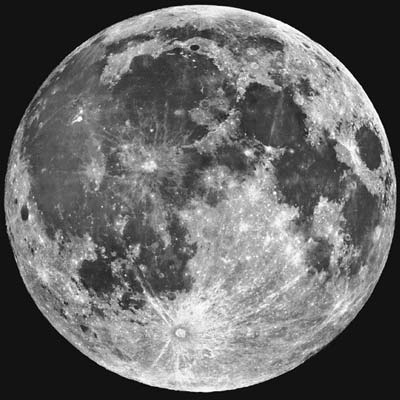
rth has one moon. A symbol in famous love songs, movies, poems, and folklore, many myths about the Moon date back to ancient history. In fact, the name Monday originates from Moon-day. The Moon glows by light it reflects from the Sun and is frequently the brightest object in the night sky. The Moon orbits the Earth about once a month (moon-th) from about 1 light second away. The above-pictured Full Moon occurs when the Moon is nearly opposite to the Sun in its orbit. The Moon's diameter is about 1/4 that of the Earth, and from the Earth's surface appears to have almost exactly the same angular size as the Sun. Recent evidence indicates that the Moon formed from a colossal impact on the Earth about 4.5 billions of years ago, and therefore has a similar composition to the Earth. Humans walked on the Moon for the first time in 1969.