The Sun
The Sun is a yellow dwarf star (G2V), about 4.6 billion years old, and the dominant gravitational force in the Solar System. It has a diameter of roughly 1.4 million kilometers and contains around 99.8% of the Solar System’s mass. Nuclear fusion in its core converts hydrogen into helium, producing energy that warms the planets. Above the core lie the radiative and convective zones, followed by the visible photosphere (~5,500 °C), the chromosphere, and the much hotter corona (~2 million °C).
Source: science.nasa.gov
APODs including "The Sun"
A Sundial for Mars
28/04/1999
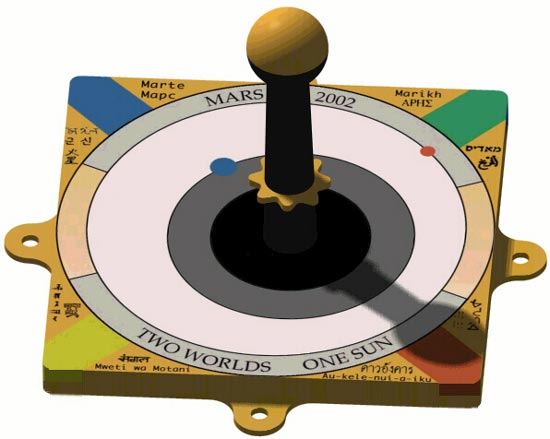
When Mars Surveyor arrives at Mars in 2002, it will carry a sundial. Even though batteries and a solar array will power the Mars Surveyor Lander, the sundial has been included to allow a prominent public display of time. The sundial idea was the brainchild of Bill Nye the Science Guy, who noticed that a post originally used for camera calibration could be redesigned. Millennia ago, sundials were state-of-the-art timekeepers for humans on Earth. Since the Sun casts similar shadows on Mars and Earth, accurate calibration of the shadow placement on the Martian Sundial will tell a curious inspector of returned images both the time of day and the season.