The Sun
The Sun is a yellow dwarf star (G2V), about 4.6 billion years old, and the dominant gravitational force in the Solar System. It has a diameter of roughly 1.4 million kilometers and contains around 99.8% of the Solar System’s mass. Nuclear fusion in its core converts hydrogen into helium, producing energy that warms the planets. Above the core lie the radiative and convective zones, followed by the visible photosphere (~5,500 °C), the chromosphere, and the much hotter corona (~2 million °C).
Source: science.nasa.gov
APODs including "The Sun"
The Sun Oscillates
15/06/1999
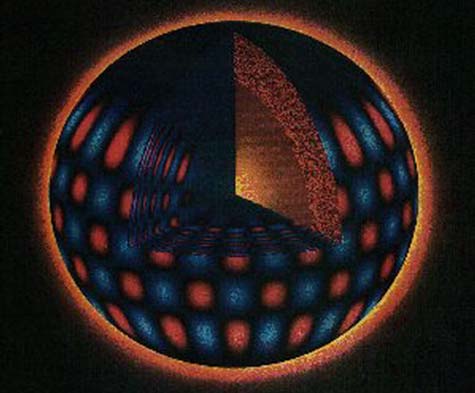
Our Sun is in a continual state of oscillation. Large patches of the Sun vibrate in and out, back and forth, even as the Sun rotates. One mode of Solar oscillation is depicted graphically above, with blue indicating outward motion, and red indicating inward motion. Although sensitive optical solar observatories can only directly detect surface motions, they give information about vibrations occurring much deeper in the Sun. In helioseismology, these oscillations are being analyzed and are revealing unprecedented information about the density, temperature, motion, and chemical composition of the entire Sun.