The Sun
The Sun is a yellow dwarf star (G2V), about 4.6 billion years old, and the dominant gravitational force in the Solar System. It has a diameter of roughly 1.4 million kilometers and contains around 99.8% of the Solar System’s mass. Nuclear fusion in its core converts hydrogen into helium, producing energy that warms the planets. Above the core lie the radiative and convective zones, followed by the visible photosphere (~5,500 °C), the chromosphere, and the much hotter corona (~2 million °C).
Source: science.nasa.gov
APODs including "The Sun"
A Sun Pillar
06/07/1999
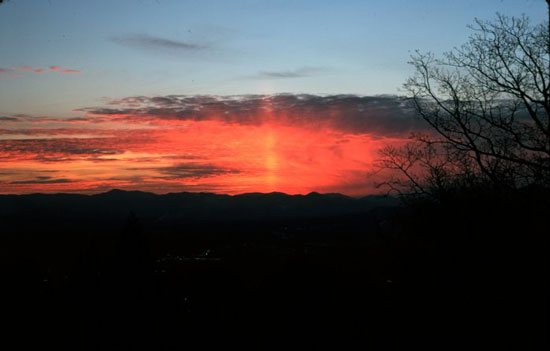
Have you ever seen a sun pillar? When the air is cold and the Sun is rising or setting, falling ice crystals can reflect sunlight and create an unusual column of light. Ice sometimes forms flat, stop-sign shaped crystals as it falls from high-level clouds. Air resistance causes these crystals to lie nearly flat much of the time as they flutter to the ground. Sunlight reflects off crystals that are properly aligned, creating the sun-pillar effect. In the above picture, the sun-pillar can be traced up to the cloud that is raining the reflecting ice-crystals.