The Sun
The Sun is a yellow dwarf star (G2V), about 4.6 billion years old, and the dominant gravitational force in the Solar System. It has a diameter of roughly 1.4 million kilometers and contains around 99.8% of the Solar System’s mass. Nuclear fusion in its core converts hydrogen into helium, producing energy that warms the planets. Above the core lie the radiative and convective zones, followed by the visible photosphere (~5,500 °C), the chromosphere, and the much hotter corona (~2 million °C).
Source: science.nasa.gov
APODs including "The Sun"
Deploying Spartan
12/08/1999
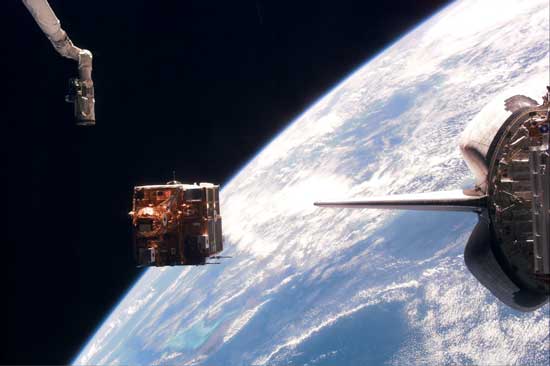
Last October the Space Shuttle Discovery deployed Spartan 201, a spacecraft that monitored the corona of the Sun. Instruments on Spartan 201 were used to estimate the density of electrons emitted into the solar corona, calibrate data from the Solar and Heliospheric Observatory (SOHO) satellite, and study how the Sun is changing as it reaches maximum activity over the next few years. Pictured above, the space shuttle's robot arm (top left) releases Spartan (center) into space. The tail fin of the space shuttle is visible on the right, while the Earth hovers in the background. Spartan floated near the shuttle for two days before it was picked up again and returned to Earth.