The Sun
The Sun is a yellow dwarf star (G2V), about 4.6 billion years old, and the dominant gravitational force in the Solar System. It has a diameter of roughly 1.4 million kilometers and contains around 99.8% of the Solar System’s mass. Nuclear fusion in its core converts hydrogen into helium, producing energy that warms the planets. Above the core lie the radiative and convective zones, followed by the visible photosphere (~5,500 °C), the chromosphere, and the much hotter corona (~2 million °C).
Source: science.nasa.gov
APODs including "The Sun"
Sundogs over the VLA
23/08/1999
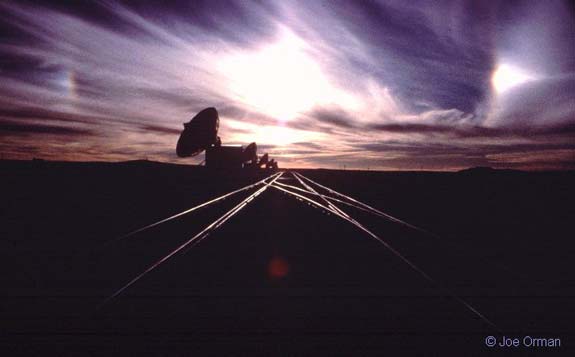
What if you woke up one morning and saw more than one Sun in the sky? Most probably, you would be seeing sundogs, extra-images of the Sun created by falling ice-crystals in the Earth's atmosphere. As water freezes in the atmosphere, small, flat, six-sided, ice crystals might be formed. As these crystals flutter to the ground, much time is spent with their faces flat, parallel to the ground. An observer may pass through the same plane as many of the falling ice crystals near sunrise or sunset. During this alignment, each crystal can act like a miniature lens, refracting sunlight into our view and creating parhelia, the technical term for sundogs. Sundogs were photographed here in a cloudy sky above the Very Large Array of radio telescopes. The real Sun is near the center above the train tracks. A bright sundog is visible on the far right, and a dim one on the far left. Ice-crystals can create other strange illusions of the Sun and Moon including halos and pillars