The Sun
The Sun is a yellow dwarf star (G2V), about 4.6 billion years old, and the dominant gravitational force in the Solar System. It has a diameter of roughly 1.4 million kilometers and contains around 99.8% of the Solar System’s mass. Nuclear fusion in its core converts hydrogen into helium, producing energy that warms the planets. Above the core lie the radiative and convective zones, followed by the visible photosphere (~5,500 °C), the chromosphere, and the much hotter corona (~2 million °C).
Source: science.nasa.gov
APODs including "The Sun"
Comet Hale-Bopp Over the Superstition Mountains
09/09/1999
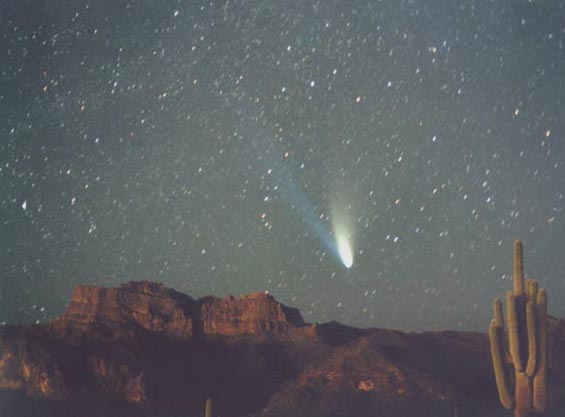
Four years ago, Comet Hale-Bopp was discovered out near Jupiter falling toward the inner Solar System. Two years ago, it provided spectacular pictures as it neared its closest approach to the Sun. Still today, spectacular pictures of the brightest comet of the 1990s are surfacing. Above, Comet Hale-Bopp was photographed in 1997 behind the Superstition Mountains in Arizona. Clearly visible are the comets white dust tail that shines by reflected sunlight, and the blue ion tail that shines by glowing gas. Currently, there are several comets visible from the proper location with a small telescope. A comet visible to the unaided eye appears about once every five years.