The Sun
The Sun is a yellow dwarf star (G2V), about 4.6 billion years old, and the dominant gravitational force in the Solar System. It has a diameter of roughly 1.4 million kilometers and contains around 99.8% of the Solar System’s mass. Nuclear fusion in its core converts hydrogen into helium, producing energy that warms the planets. Above the core lie the radiative and convective zones, followed by the visible photosphere (~5,500 °C), the chromosphere, and the much hotter corona (~2 million °C).
Source: science.nasa.gov
APODs including "The Sun"
Stonehenge: Ancient Monument to the Sun
12/09/1999
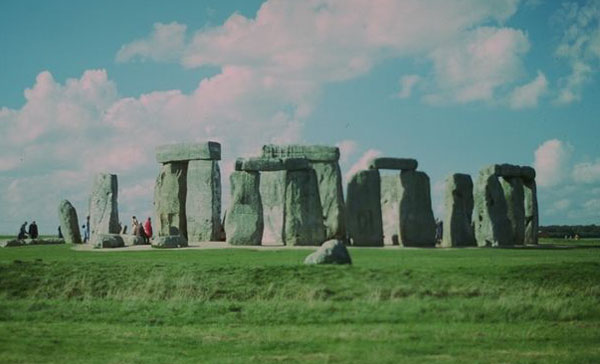
Stonehenge consists of large carved stones assembled about 4000 years ago. Long before modern England was established, ancient inhabitants somehow moved 25 ton rocks nearly 20 miles to complete it. From similar constructs of the era, people could learn the time of year by watching how the Sun and Moon rose and set relative to accurately placed stones and pits. The placement of the boulders at Stonehenge, however, is not impressively accurate by today's standards, nor even by the standards of that time. Therefore, modern scholars interpret Stonehenge as a colossal monument to the Sun in celebration of the predictability of the seasons.