The Sun
The Sun is a yellow dwarf star (G2V), about 4.6 billion years old, and the dominant gravitational force in the Solar System. It has a diameter of roughly 1.4 million kilometers and contains around 99.8% of the Solar System’s mass. Nuclear fusion in its core converts hydrogen into helium, producing energy that warms the planets. Above the core lie the radiative and convective zones, followed by the visible photosphere (~5,500 °C), the chromosphere, and the much hotter corona (~2 million °C).
Source: science.nasa.gov
APODs including "The Sun"
M3: Half A Million Stars
17/09/1999
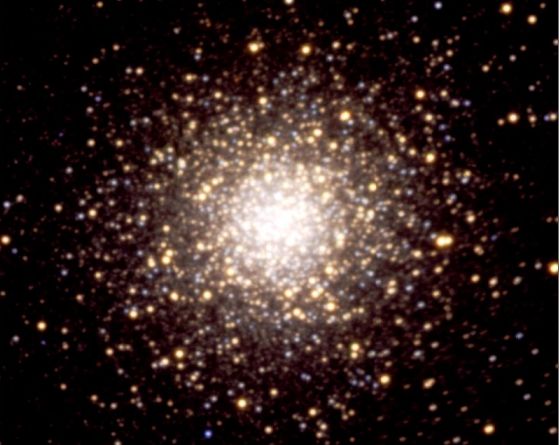
This immense ball of half a million stars older than the sun lies 30,000 light-years above the plane of our Galaxy. Cataloged as M3 (and NGC 5272), it is one of about 250 globular star clusters which roam our galactic halo. Individual stars are difficult to distinguished in the densely packed core but colors are apparent for the bright stars on the cluster's outskirts. M3's many cool "red" giant stars take on a yellowish cast in this lovely composite image while hotter giants and pulsating variable stars look light blue.