The Sun
The Sun is a yellow dwarf star (G2V), about 4.6 billion years old, and the dominant gravitational force in the Solar System. It has a diameter of roughly 1.4 million kilometers and contains around 99.8% of the Solar System’s mass. Nuclear fusion in its core converts hydrogen into helium, producing energy that warms the planets. Above the core lie the radiative and convective zones, followed by the visible photosphere (~5,500 °C), the chromosphere, and the much hotter corona (~2 million °C).
Source: science.nasa.gov
APODs including "The Sun"
Follow The Spots
21/10/1999
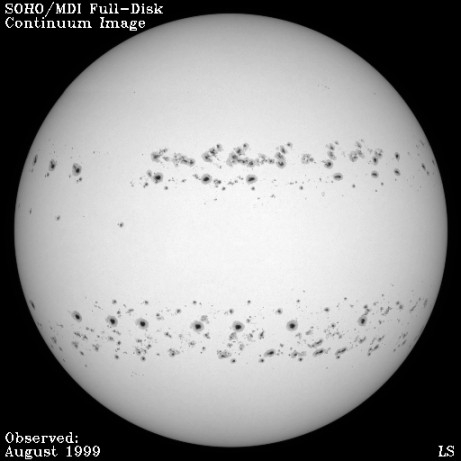
The Sun rotates on its axis about once every 27 days. How can you tell? Just follow the sunspots. This composite picture was constructed from solar images recorded daily by the MDI instrument on board the space-based SOlar and Heliospheric Observatory (SOHO). It shows the Sun's visible surface for most days of August 1999 so that the same sunspots appear many times as the solar rotation carries them across the face of the Sun. Sunspot temperatures are around 5,000 degrees C. but the spots appear dark as they are actually cooler than the surrounding regions of the solar surface. The sequential images of the sunspot groups show how these regions with high magnetic fields change from day to day.