The Sun
The Sun is a yellow dwarf star (G2V), about 4.6 billion years old, and the dominant gravitational force in the Solar System. It has a diameter of roughly 1.4 million kilometers and contains around 99.8% of the Solar System’s mass. Nuclear fusion in its core converts hydrogen into helium, producing energy that warms the planets. Above the core lie the radiative and convective zones, followed by the visible photosphere (~5,500 °C), the chromosphere, and the much hotter corona (~2 million °C).
Source: science.nasa.gov
APODs including "The Sun"
Mercury And The Sun
19/11/1999
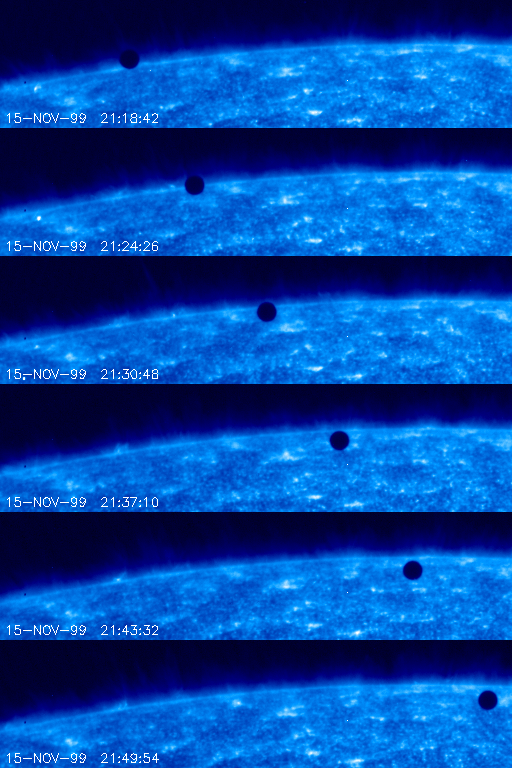
Just days before the peak of the Leonid meteor shower, skywatchers were offered another astronomical treat as planet Mercury crossed the face of the Sun on November 15. Viewed from planet Earth, a transit of Mercury is not all that rare. The last occurred in 1993 and the next will happen in 2003. Enjoying a mercurial transit does require an appropriately filtered telescope, still the event can be dramatic as the diminutive well-done world drifts past the dominating solar disk. This slow loading gif animation is based on images recorded by the earth-orbiting TRACE satellite. The false-color TRACE images were made in ultraviolet light and tend to show the hot gas just above the Sun's visible surface. Mercury's disk is silhouetted against the seething plasma as it follows a trajectory near the edge of the Sun.