The Sun
The Sun is a yellow dwarf star (G2V), about 4.6 billion years old, and the dominant gravitational force in the Solar System. It has a diameter of roughly 1.4 million kilometers and contains around 99.8% of the Solar System’s mass. Nuclear fusion in its core converts hydrogen into helium, producing energy that warms the planets. Above the core lie the radiative and convective zones, followed by the visible photosphere (~5,500 °C), the chromosphere, and the much hotter corona (~2 million °C).
Source: science.nasa.gov
APODs including "The Sun"
Unusual Aurora During Solar Wind Dropout
23/12/1999
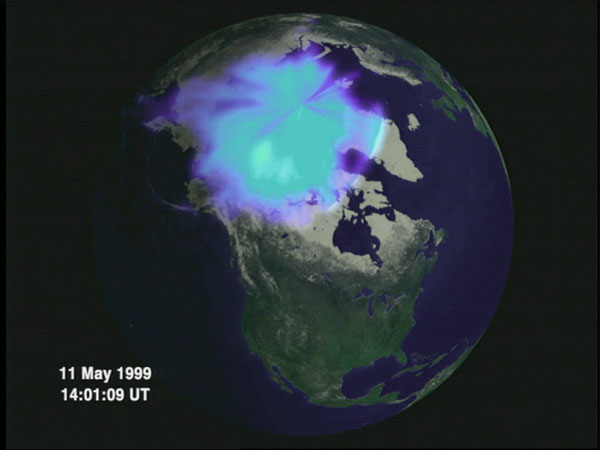
On May 10, for some unknown reason, the Solar Wind virtually stopped. Normally our Sun emits a wind of between five and ten energetic particles per cubic centimeter moving outward at about 500 kilometers per second. Late on May 10, however, this gale was reduced to a mere breeze of one particle per every five cubic centimeters. The Sun's Corona was suddenly able to flow out into the Solar System relatively unimpeded, creating beams of energetic electrons. One such beam apparently reached Earth's North Magnetic Pole, and was seen as the unusual X-ray aurora digitally reconstructed in the above false-color image. Our atmosphere absorbed the electrons. This display gave direct evidence, however, that Earth's North Magnetic Pole was connected to the Sun, while the Earth's South Magnetic Pole connected to the distant Solar System. The Solar Wind returned to normal on May 12.