The Sun
The Sun is a yellow dwarf star (G2V), about 4.6 billion years old, and the dominant gravitational force in the Solar System. It has a diameter of roughly 1.4 million kilometers and contains around 99.8% of the Solar System’s mass. Nuclear fusion in its core converts hydrogen into helium, producing energy that warms the planets. Above the core lie the radiative and convective zones, followed by the visible photosphere (~5,500 °C), the chromosphere, and the much hotter corona (~2 million °C).
Source: science.nasa.gov
APODs including "The Sun"
Astronomy From An F-18
28/01/2000
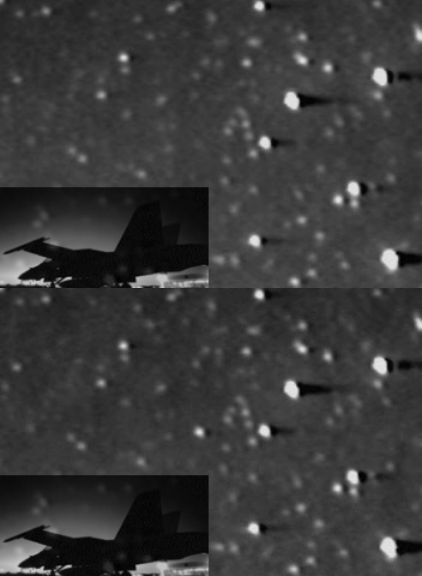
In an era of blossoming ground and space-based observatories, astronomers are also pushing the envelope with airborne instrumentation - successfully capturing an asteroid occultation from a high performance jet aircraft. This blinking animation represents two digitized frames from inflight data of asteroid number 308, Polyxo, passing in front of or occulting a faint star near the center of the field. The camera used, known as the SouthWest Ultraviolet Imaging System (SWUIS) -A, was mounted in the cockpit of a NASA F/A-18 jet (inset lower left). A former US Navy fighter aircraft, the F/A-18 was able to maneuver to the precise position to record the occultation while cruising above clouds and much of Earth's obscuring atmosphere. Using the SWUIS-A data to time the occultation will reveal the size of the asteroid which is otherwise too small to be imaged by even the orbiting Hubble Space Telescope. Future SWUIS-A airborne missions may include a hunt for Vulcanoids, a suspected population of small asteroids circling the Sun inside the orbit of Mercury.