The Sun
The Sun is a yellow dwarf star (G2V), about 4.6 billion years old, and the dominant gravitational force in the Solar System. It has a diameter of roughly 1.4 million kilometers and contains around 99.8% of the Solar System’s mass. Nuclear fusion in its core converts hydrogen into helium, producing energy that warms the planets. Above the core lie the radiative and convective zones, followed by the visible photosphere (~5,500 °C), the chromosphere, and the much hotter corona (~2 million °C).
Source: science.nasa.gov
APODs including "The Sun"
Eros Encounter Nears
10/02/2000
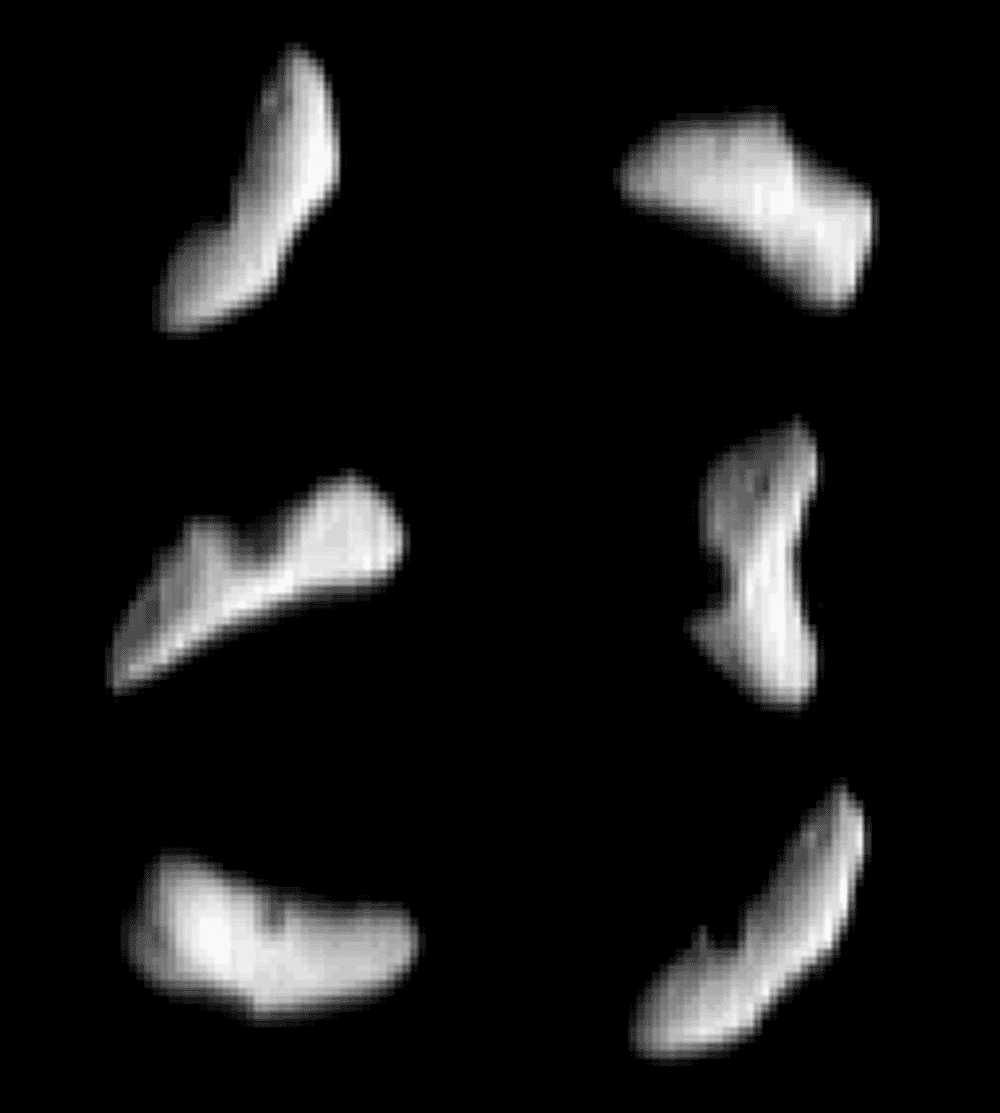
After an unanticipated extra trip around the Sun, the NEAR spacecraft is now politely approaching asteroid 433, Eros, at a respectful relative speed of about 20 miles per hour. Still nearly 2,000 miles distant, NEAR will close to within approximately 200 miles by February 14th - Valentine's Day. If all goes well, the spacecraft will then be captured by the gentle attraction of Eros' gravity, becoming the first artificial moon of an asteroid. While Eros is not round it is certainly not heart-shaped either as seen in this series of frames showing the roughly 20 x 8 x 8 mile asteroid during its 5.27 hour rotation period. Different perspectives clearly show a gouge or saddle and a large impact crater with a raised rim near the asteroid's narrow waist. The frames were recorded by the NEAR spacecraft's multi-spectral imager on February 4th from a range of 4,600 miles.