The Sun
The Sun is a yellow dwarf star (G2V), about 4.6 billion years old, and the dominant gravitational force in the Solar System. It has a diameter of roughly 1.4 million kilometers and contains around 99.8% of the Solar System’s mass. Nuclear fusion in its core converts hydrogen into helium, producing energy that warms the planets. Above the core lie the radiative and convective zones, followed by the visible photosphere (~5,500 °C), the chromosphere, and the much hotter corona (~2 million °C).
Source: science.nasa.gov
APODs including "The Sun"
Flying Over Asteroid Eros
27/03/2000
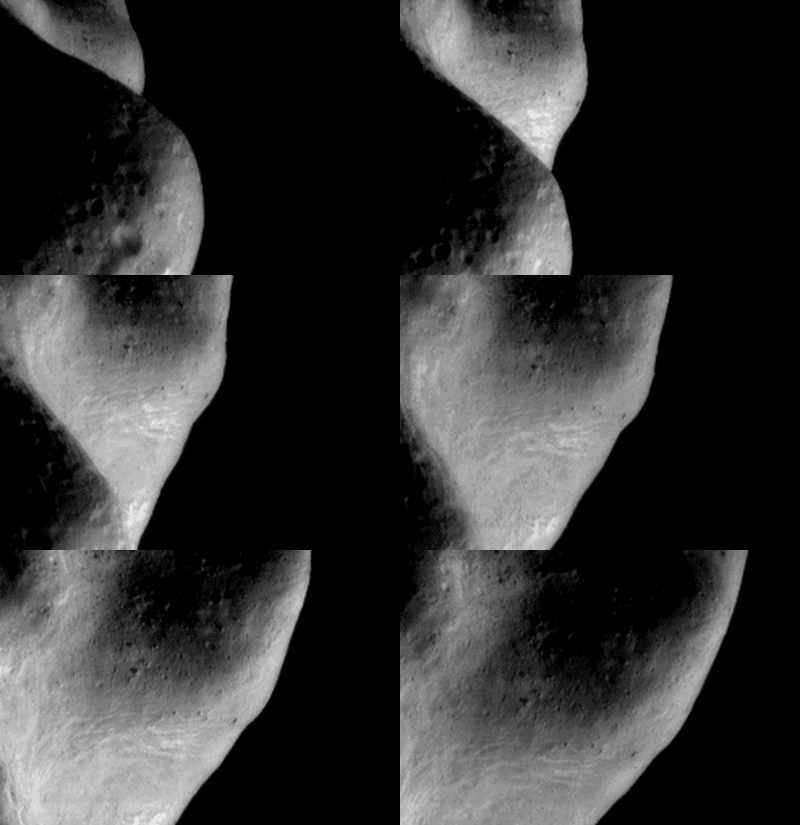
What would it look like to fly over an asteroid? Spacecraft NEAR Shoemaker in orbit around asteroid 433 Eros found out earlier this month when it recorded its first fly-over sequence. The saddle region of the Sun-orbiting space-mountain appears to zip past the camera in this condensed hour-long time-lapse sequence. The spacecraft was orbiting about 200 kilometers above the asteroid. Movies such as this are scientifically useful for discerning between regions that are naturally dark and regions that have their brightness dominated by shadows. The week before, a bright X-ray burst from the Sun allowed NEAR's X-ray spectrometer to detect the presence of several elements on Eros' surface by their X-ray fluorescent signatures.