The Sun
The Sun is a yellow dwarf star (G2V), about 4.6 billion years old, and the dominant gravitational force in the Solar System. It has a diameter of roughly 1.4 million kilometers and contains around 99.8% of the Solar System’s mass. Nuclear fusion in its core converts hydrogen into helium, producing energy that warms the planets. Above the core lie the radiative and convective zones, followed by the visible photosphere (~5,500 °C), the chromosphere, and the much hotter corona (~2 million °C).
Source: science.nasa.gov
APODs including "The Sun"
Venus, Moon, and Neighbors
06/04/2000
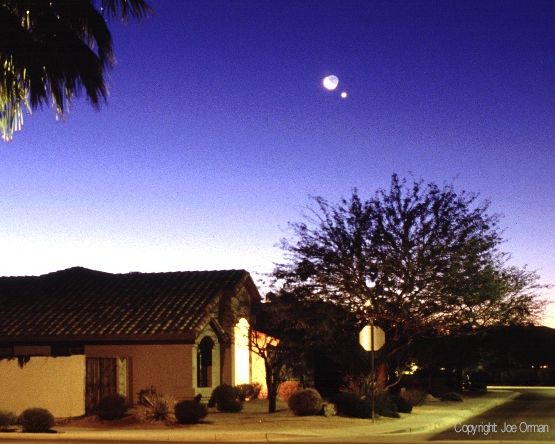
Rising before the Sun on February 2nd, astrophotographer Joe Orman anticipated this apparition of the bright morning star Venus near a lovely crescent Moon above a neighbor's house in suburban Phoenix, Arizona, USA. Fortunately, the alignment of bright planets and the Moon is one of the most inspiring sights in the night sky and one that is often easy to enjoy and share without any special equipment. Take tonight, for example. Those blessed with clear skies can simply step outside near sunset and view a young crescent Moon very near three bright planets in the west Jupiter, Mars, and Saturn. Jupiter will be the unmistakable brightest star near the Moon with a reddish Mars just to Jupiter's north and pale yellow Saturn directly above. Of course, these sky shows create an evocative picture but the planets and Moon just appear to be near each other -- they are actually only approximately lined up and lie in widely separated orbits. Unfortunately, next month's highly publicized alignment of planets on May 5th will be lost from view in the Sun's glare but such planetary alignments occur repeatedly and pose no danger to planet Earth.