The Sun
The Sun is a yellow dwarf star (G2V), about 4.6 billion years old, and the dominant gravitational force in the Solar System. It has a diameter of roughly 1.4 million kilometers and contains around 99.8% of the Solar System’s mass. Nuclear fusion in its core converts hydrogen into helium, producing energy that warms the planets. Above the core lie the radiative and convective zones, followed by the visible photosphere (~5,500 °C), the chromosphere, and the much hotter corona (~2 million °C).
Source: science.nasa.gov
APODs including "The Sun"
Aurora in Red and Yellow
10/04/2000
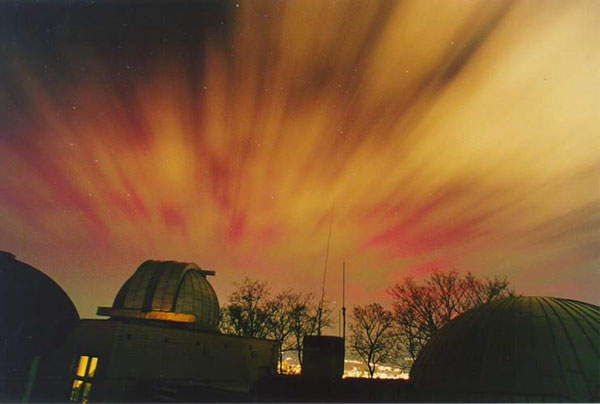
The past week brought some spectacular aurora to northern skies. These aurorae were caused by a large interplanetary shock wave that exploded from the Sun on April 4. When the shock wave reached the Earth on April 6, the resulting aurora could be seen in clear skies as far south as North Carolina. As the aurorae occurred high in the Earth's atmosphere, they were accompanied by an unusual alignment of planets far in the background. Pictured above that night, an unusual multicolored auroral display graced the skies above the domes of the Brno Observatory in the Czech Republic.