The Sun
The Sun is a yellow dwarf star (G2V), about 4.6 billion years old, and the dominant gravitational force in the Solar System. It has a diameter of roughly 1.4 million kilometers and contains around 99.8% of the Solar System’s mass. Nuclear fusion in its core converts hydrogen into helium, producing energy that warms the planets. Above the core lie the radiative and convective zones, followed by the visible photosphere (~5,500 °C), the chromosphere, and the much hotter corona (~2 million °C).
Source: science.nasa.gov
APODs including "The Sun"
Light Bridges on the Sun
22/05/2000
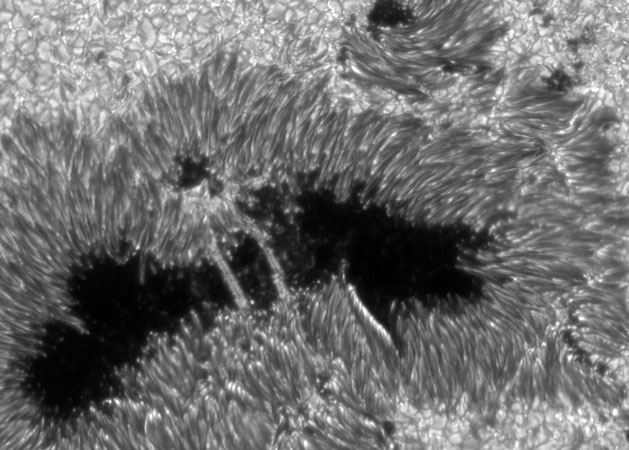
Bridges the length of a planet can form on the Sun in a matter of hours. Known as light bridges, these structures may form as large sunspot groups decay. Above, one of the sharpest photographs of the Sun ever taken shows two such light bridges that appeared late last month. The 5000-kilometer long bridges connect moderately dark penumbral regions across the cool abyss of two dark sunspot umbras. A movie shows that material tends more to rise from below and fall rather than to cross the light bridges. Bright bubbling granules surround the sunspot group. The impressive details on this recently released picture from the Swedish Solar Vacuum Telescope were made possible by new adaptive optics that correct for the blurring of the Earth's atmosphere. What eventually became of the light bridges? As days progressed, the bridge region expanded to fill the void as the sunspots moved apart and decayed.