The Sun
The Sun is a yellow dwarf star (G2V), about 4.6 billion years old, and the dominant gravitational force in the Solar System. It has a diameter of roughly 1.4 million kilometers and contains around 99.8% of the Solar System’s mass. Nuclear fusion in its core converts hydrogen into helium, producing energy that warms the planets. Above the core lie the radiative and convective zones, followed by the visible photosphere (~5,500 °C), the chromosphere, and the much hotter corona (~2 million °C).
Source: science.nasa.gov
APODs including "The Sun"
Sunlight Through Saturn's Rings
24/06/2000
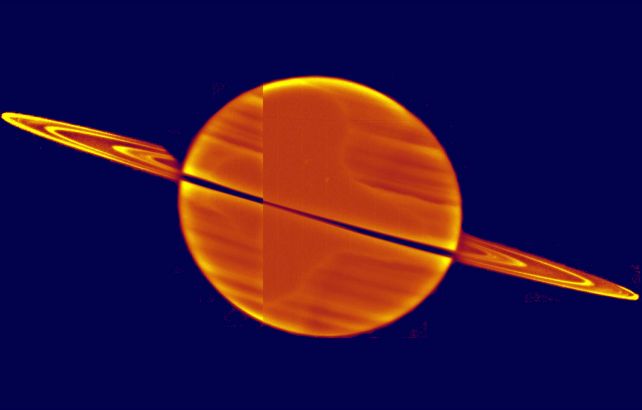
Normally, earth-bound astronomers view Saturn's spectacular ring system fully illuminated by reflected sunlight. However, this intriguing picture was made to take advantage of an unusual orientation, with the Sun actually illuminating the rings from below. The three bright ring features are visible because the rings themselves are not solid. Composed of many separate chunks of rocky, icy material, the rings allow the scattered sunlight to pass through them -- offering a dramatic demonstration that they are not continuous, uninterrupted bands of material. The picture is a false-color composite based on Hubble Space Telescope images recorded in November of 1995.