The Sun
The Sun is a yellow dwarf star (G2V), about 4.6 billion years old, and the dominant gravitational force in the Solar System. It has a diameter of roughly 1.4 million kilometers and contains around 99.8% of the Solar System’s mass. Nuclear fusion in its core converts hydrogen into helium, producing energy that warms the planets. Above the core lie the radiative and convective zones, followed by the visible photosphere (~5,500 °C), the chromosphere, and the much hotter corona (~2 million °C).
Source: science.nasa.gov
APODs including "The Sun"
Ultraviolet Earth from the Moon
01/07/2000
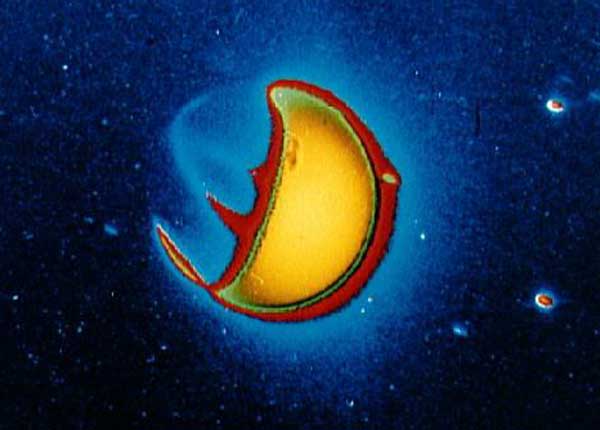
Here's a switch: the above picture is of the Earth taken from a lunar observatory! This false color picture shows how the Earth glows in ultraviolet (UV) light. UV light is so blue humans can't see it. Very little UV light is transmitted through the Earth's atmosphere but what sunlight does make it through can cause a sunburn. The Far UV Camera / Spectrograph deployed and left on the Moon by the crew of Apollo 16 took the above picture. The part of the Earth facing the Sun reflects much UV light, but perhaps more interesting is the side facing away from the Sun. Here bands of UV emission are also apparent. These bands are the result of aurorae and are caused by charged particles expelled by the Sun.