The Sun
The Sun is a yellow dwarf star (G2V), about 4.6 billion years old, and the dominant gravitational force in the Solar System. It has a diameter of roughly 1.4 million kilometers and contains around 99.8% of the Solar System’s mass. Nuclear fusion in its core converts hydrogen into helium, producing energy that warms the planets. Above the core lie the radiative and convective zones, followed by the visible photosphere (~5,500 °C), the chromosphere, and the much hotter corona (~2 million °C).
Source: science.nasa.gov
APODs including "The Sun"
LP 944-20: A Failed Star Flares
13/07/2000
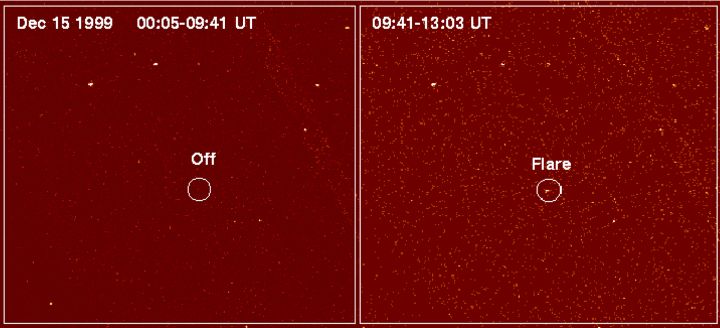
The tiny spot circled on the right actually represents a big astronomical discovery -- the first detected flare from a failed star. Failed stars, termed brown dwarfs in astronomers' parlance, are too low in mass to ignite nuclear hydrogen burning in their cores, yet still shine feebly as the energy from their gravitational collapse is converted to heat and light. In fact, the dim brown dwarf cataloged as LP944-20 is estimated to have only 6 percent the mass of the Sun (60 times the mass of Jupiter) and one-tenth the Sun's diameter. A mere 16 light-years distant in the southern constellation Fornax it is well studied, but this failed star recently startled astronomers by producing a flare visible at x-ray energies. The above Chandra X-ray Observatory images of the LP944-20 star field were recorded in December 1999. Showing nothing (left) for the first nine hours, the brown dwarf generated a significant x-ray flare during the final hours of the observation. How did a failed star produced such a high-energy flare? Magnetic fields twisted and broken by turbulent motions near the surface of the brown dwarf may be the culprit. Difficult to detect because they are otherwise faint, brown dwarf stars are believed to be common throughout the galaxy.