The Sun
The Sun is a yellow dwarf star (G2V), about 4.6 billion years old, and the dominant gravitational force in the Solar System. It has a diameter of roughly 1.4 million kilometers and contains around 99.8% of the Solar System’s mass. Nuclear fusion in its core converts hydrogen into helium, producing energy that warms the planets. Above the core lie the radiative and convective zones, followed by the visible photosphere (~5,500 °C), the chromosphere, and the much hotter corona (~2 million °C).
Source: science.nasa.gov
APODs including "The Sun"
Tails Of Comet LINEAR
27/07/2000
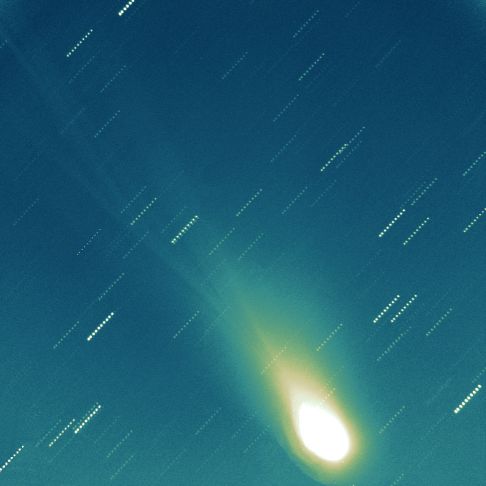
Comet C/1999 S4 LINEAR is only one of many comets discovered with the Lincoln Near Earth Asteroid Research (LINEAR) telescope operating near Soccoro, New Mexico, USA. Traveling steadily southward through Earth's night sky, C/1999 S4 passed perihelion (closest approach to the Sun) yesterday on what is likely its first trip through the inner solar system. Now fading, comet LINEAR became no brighter than about 6th magnitude, but is still easily visible with binoculars in northern hemisphere skies. While the memorable comets Hale-Bopp and Hyakutake were much brighter, comet LINEAR is displaying delightful tails evident in this false-color composite image from the Crni Vrh Observatory in Slovenia. The combined series of exposures made on July 22nd are registered on the comet. In the resulting picture, stars appear as rows of dots, but the faint structures in the comet's tail are beautifully recorded. Presently seen moving from Ursa Major to Leo this comet LINEAR will begin to shine in southern hemisphere skies in August.