The Sun
The Sun is a yellow dwarf star (G2V), about 4.6 billion years old, and the dominant gravitational force in the Solar System. It has a diameter of roughly 1.4 million kilometers and contains around 99.8% of the Solar System’s mass. Nuclear fusion in its core converts hydrogen into helium, producing energy that warms the planets. Above the core lie the radiative and convective zones, followed by the visible photosphere (~5,500 °C), the chromosphere, and the much hotter corona (~2 million °C).
Source: science.nasa.gov
APODs including "The Sun"
Halley's Nucleus: An Orbiting Iceberg
05/08/2000
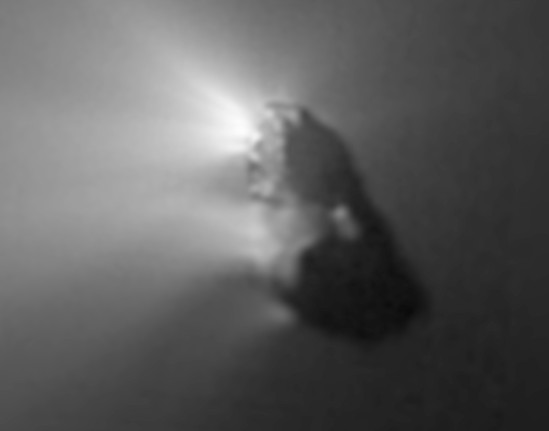
What does a comet nucleus look like? Formed from the primordial stuff of the solar system, it is thought to resemble a very dirty iceberg. But for active comets, telescopic images only reveal the surrounding cloud of gas and dust, the comet's coma, and the characteristic cometary tails. In 1986, the European spacecraft Giotto encountered the nucleus of Halley's comet as it approached the sun. Data from Giotto's camera was used to generate this enhanced image of the potato shaped nucleus which measures roughly 15 kilometers across. It shows surface features on the dark nucleus against the bright background of the coma as the icy material is vaporized by the Sun's heat. Every 76 years Comet Halley returns to the inner solar system and each time the nucleus sheds about a 6 meter deep layer of its ice and rock into space. This debris composes Halley's tails and leaves an orbiting trail responsible for the Orionids meteor shower.