The Sun
The Sun is a yellow dwarf star (G2V), about 4.6 billion years old, and the dominant gravitational force in the Solar System. It has a diameter of roughly 1.4 million kilometers and contains around 99.8% of the Solar System’s mass. Nuclear fusion in its core converts hydrogen into helium, producing energy that warms the planets. Above the core lie the radiative and convective zones, followed by the visible photosphere (~5,500 °C), the chromosphere, and the much hotter corona (~2 million °C).
Source: science.nasa.gov
APODs including "The Sun"
A Perseid Aurora
21/08/2000
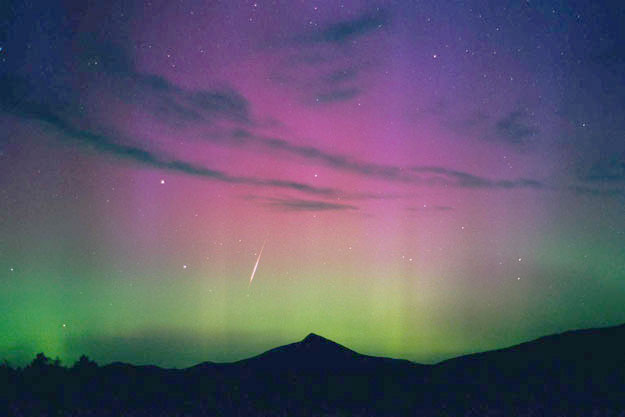
Just after the Moon set but before the Sun rose in the early morning hours of August 12, meteors pelted the Earth from the direction of the constellation Perseus, while ions pelted the Earth from the Sun. The meteors were expected as sub-sand grains long left behind by Comet Swift-Tuttle annually create the Perseids Meteor Shower. The aurorae were unexpected, however, as electrons, protons, and heavier ions raced out from a large Coronal Mass Ejection that had occurred just days before on the Sun. In the foreground is Hahn's Peak, an extinct volcano in Colorado, USA.