The Sun
The Sun is a yellow dwarf star (G2V), about 4.6 billion years old, and the dominant gravitational force in the Solar System. It has a diameter of roughly 1.4 million kilometers and contains around 99.8% of the Solar System’s mass. Nuclear fusion in its core converts hydrogen into helium, producing energy that warms the planets. Above the core lie the radiative and convective zones, followed by the visible photosphere (~5,500 °C), the chromosphere, and the much hotter corona (~2 million °C).
Source: science.nasa.gov
APODs including "The Sun"
Heating Coronal Loops
28/09/2000
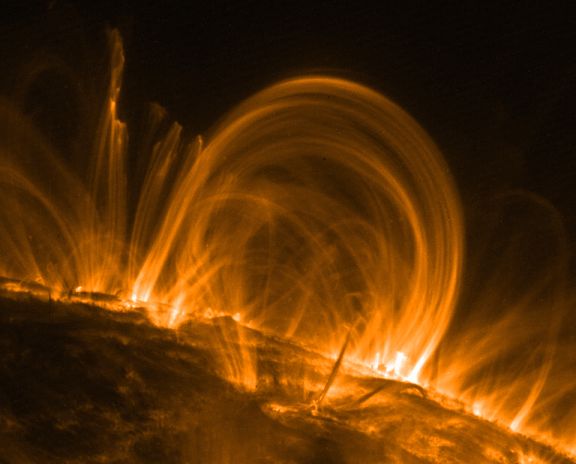
ending above the photosphere or visible surface of the Sun, the faint, tenuous solar corona can't be easily seen from Earth, but it is measured to be hundreds of times hotter than the photosphere itself. What makes the solar corona so hot? Astronomers have long sought the source of the corona's heat in magnetic fields which loft monstrous loops of solar plasma above the photosphere. Still, new and dramatically detailed observations of coronal loops from the orbiting TRACE satellite are now pointing more closely to the unidentified energy source. Recorded in extreme ultraviolet light, this and other TRACE images indicate that most of the heating occurs low in the corona, near the bases of the loops as they emerge from and return to the solar surface. The new results confound the conventional theory which relies on heating the loops uniformly. This tantalizing TRACE image shows clusters of the majestic, hot coronal loops which span 30 or more times the diameter of planet Earth.