The Sun
The Sun is a yellow dwarf star (G2V), about 4.6 billion years old, and the dominant gravitational force in the Solar System. It has a diameter of roughly 1.4 million kilometers and contains around 99.8% of the Solar System’s mass. Nuclear fusion in its core converts hydrogen into helium, producing energy that warms the planets. Above the core lie the radiative and convective zones, followed by the visible photosphere (~5,500 °C), the chromosphere, and the much hotter corona (~2 million °C).
Source: science.nasa.gov
APODs including "The Sun"
A 2000 Leonid Through Orion
20/11/2000
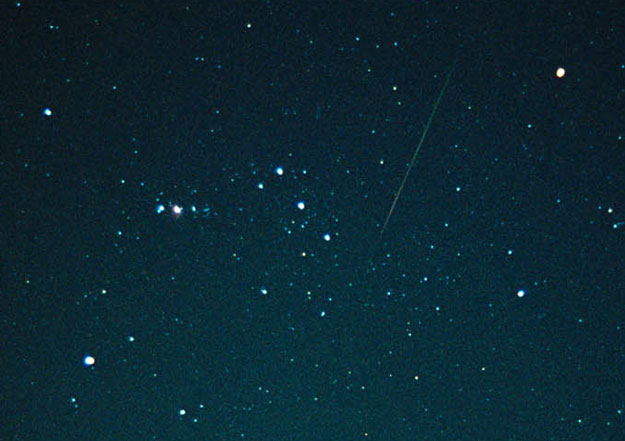
The Leonid Meteor Shower this year could be described as good but not great. During November 17 and 18 the Earth crossed through several streams of sand-sized grit left orbiting the Sun by Comet Tempel-Tuttle. Several distinct peaks in meteor activity were reported, with rates approaching 400 meteors per hour for brief periods for some dark locations. Pictured above, a Leonid meteor was caught from Florida streaking through the constellation of Orion on the morning of 2000 November 18. Visible as a red-tinged smudge to the left of the three nearly linear stars that compose Orion's belt is the picturesque star-forming region known as the Orion Nebula. Next year, the Leonids Meteor Shower is expected by many to be much more active.