The Sun
The Sun is a yellow dwarf star (G2V), about 4.6 billion years old, and the dominant gravitational force in the Solar System. It has a diameter of roughly 1.4 million kilometers and contains around 99.8% of the Solar System’s mass. Nuclear fusion in its core converts hydrogen into helium, producing energy that warms the planets. Above the core lie the radiative and convective zones, followed by the visible photosphere (~5,500 °C), the chromosphere, and the much hotter corona (~2 million °C).
Source: science.nasa.gov
APODs including "The Sun"
The Eclipse Tree
25/12/2000
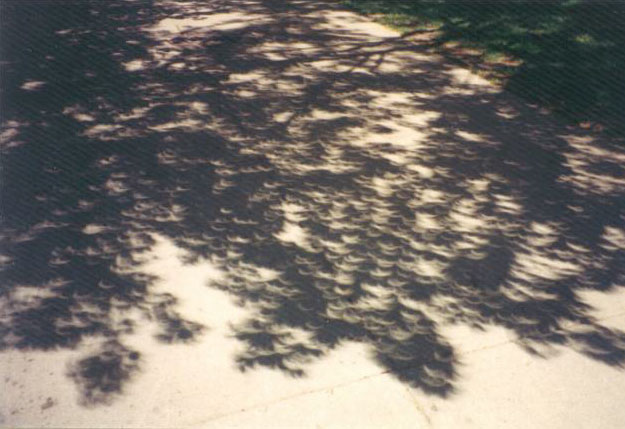
If you look closely at the shadow of this tree, you will see something quite unusual: it is composed of hundreds of images of a partially eclipsed Sun. Early today, trees across North America will be casting similar shadows as a partial eclipse of the Sun takes place. In a partial eclipse, the Moon does not cover the entire Sun. The above effect is created by small spaces between leaves and branches acting as pinhole lenses. Looking at shadows involving eclipse light is relatively safe - looking directly at the Sun, even during an eclipse, is dangerous and proper precautions should be taken. The above picture was taken in 1994 on the campus of Northwestern University.