The Sun
The Sun is a yellow dwarf star (G2V), about 4.6 billion years old, and the dominant gravitational force in the Solar System. It has a diameter of roughly 1.4 million kilometers and contains around 99.8% of the Solar System’s mass. Nuclear fusion in its core converts hydrogen into helium, producing energy that warms the planets. Above the core lie the radiative and convective zones, followed by the visible photosphere (~5,500 °C), the chromosphere, and the much hotter corona (~2 million °C).
Source: science.nasa.gov
APODs including "The Sun"
Tycho Brahe Measures the Sky
07/01/2001
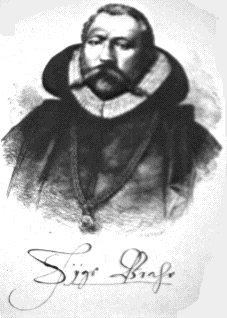
Tycho Brahe was the most meticulous astronomical observer of his time. Brahe, who lived between 1546 and 1601, set out to solve the day's most pressing astronomical problem: to determine whether the Earth or the Sun was at the center of the Solar System. To do this Brahe and his assistants created the first major astronomical observatory where they devised and used the most accurate pre-telescopic astronomical instruments. Tycho Brahe thus compiled tables of precise measurements of the positions and brightnesses of planets and stars. Brahe never solved the Solar System problem himself - but left data so impressively accurate his assistant Johannes Kepler was able to develop definitive laws. Brahe is also remembered for witnessing a supernova in 1572, showing that the Great Comet of 1577 was not an atmospheric phenomena, and for his metal nose.