The Sun
The Sun is a yellow dwarf star (G2V), about 4.6 billion years old, and the dominant gravitational force in the Solar System. It has a diameter of roughly 1.4 million kilometers and contains around 99.8% of the Solar System’s mass. Nuclear fusion in its core converts hydrogen into helium, producing energy that warms the planets. Above the core lie the radiative and convective zones, followed by the visible photosphere (~5,500 °C), the chromosphere, and the much hotter corona (~2 million °C).
Source: science.nasa.gov
APODs including "The Sun"
NGC 3603: X-Rays From A Starburst Cluster
24/01/2001
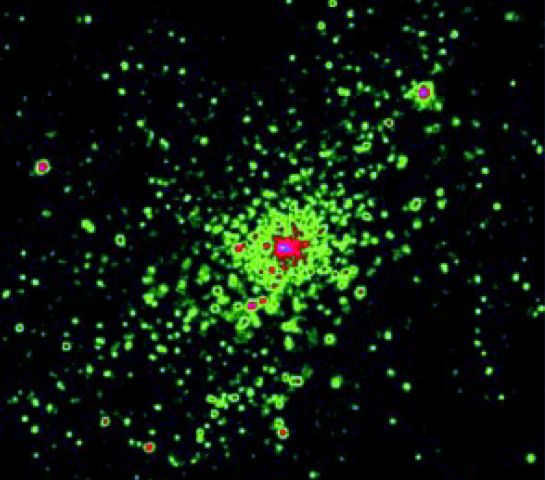
A mere 20,000 light-years from the Sun lies the NGC 3603 star cluster, a resident of the nearby Carina spiral arm of our Milky Way galaxy. Seen here in this recent false-color x-ray image from the Chandra Observatory, NGC 3603 is well known to astronomers as a young cluster in a large galactic star-forming region. The image colors were chosen to show the relative x-ray brightness of the many individual sources present, where green are faint and red to purple hues are bright sources of x-rays. The stars in the cluster were formed in a single "burst" of star formation only one or two million years ago, so the x-rays are believed to come from the massive young stars themselves or from their energetic stellar winds. Since other common galactic sources of x-rays such as supernova remnants and neutron stars represent final stages in the life of a massive star, they are unlikely to be present in such a young cluster. Nearby NGC 3603 is thought to be a convenient example of the star clusters that populate distant starburst galaxies.