The Sun
The Sun is a yellow dwarf star (G2V), about 4.6 billion years old, and the dominant gravitational force in the Solar System. It has a diameter of roughly 1.4 million kilometers and contains around 99.8% of the Solar System’s mass. Nuclear fusion in its core converts hydrogen into helium, producing energy that warms the planets. Above the core lie the radiative and convective zones, followed by the visible photosphere (~5,500 °C), the chromosphere, and the much hotter corona (~2 million °C).
Source: science.nasa.gov
APODs including "The Sun"
Equinox + 1
30/03/2001
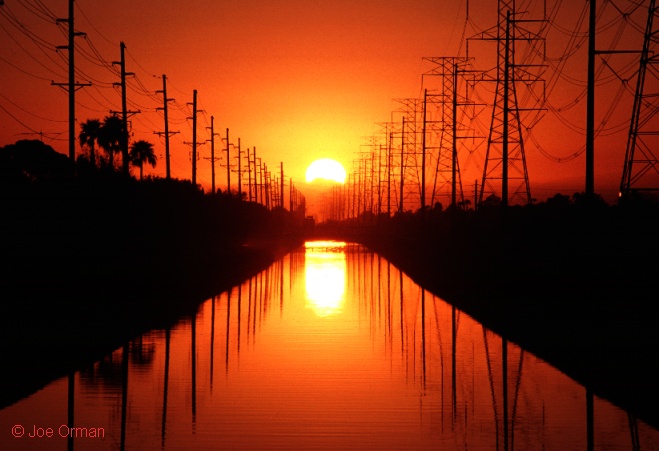
Twice a year, at the Spring and Fall equinox, the Sun rises due east. In an emphatic demonstration of this celestial alignment, photographer Joe Orman recorded this inspiring image of the Sun rising exactly along the east-west oriented Western Canal, in Tempe, Arizona, USA. But he waited until March 21st, one day after the equinox, to photograph the striking view. Why was the rising Sun due east one day after the equinox? At Tempe's latitude the Sun rises at an angle, arcing southward as it climbs above the horizon. Because the distant mountains hide the true horizon, the Sun shifts slightly southward by the time it clears the mountain tops. Waiting 24 hours allowed the Sun to rise just north of east and arc back to an exactly eastern alignment for the photo. Orman also notes that this picture carries a special significance as we experience the maximum of the solar activity cycle. The electricity and telephone transmission lines along the canal symbolize power and communications grids which are most vulnerable to outbursts from the active Sun.