The Sun
The Sun is a yellow dwarf star (G2V), about 4.6 billion years old, and the dominant gravitational force in the Solar System. It has a diameter of roughly 1.4 million kilometers and contains around 99.8% of the Solar System’s mass. Nuclear fusion in its core converts hydrogen into helium, producing energy that warms the planets. Above the core lie the radiative and convective zones, followed by the visible photosphere (~5,500 °C), the chromosphere, and the much hotter corona (~2 million °C).
Source: science.nasa.gov
APODs including "The Sun"
Aurora Over New Zealand
06/04/2001
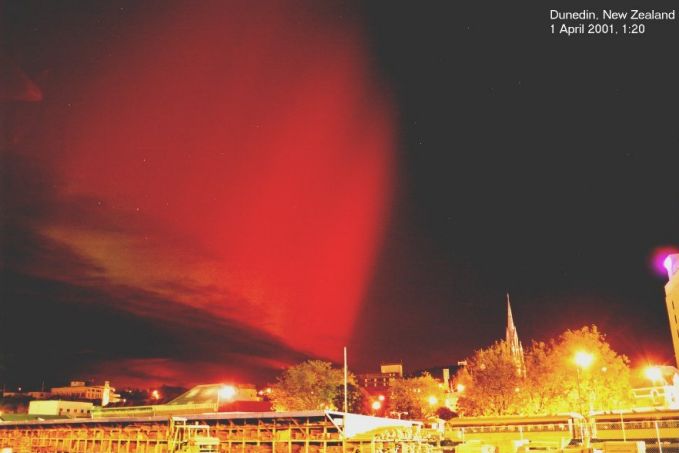
Last weekend skygazers at middle and high latitudes around the globe were treated to expansive auroral displays as a magnetic storm raged around planet Earth. The storm was triggered by a solar coronal mass ejection associated with the giant sunspot group cataloged as active region number 9393. For example, pictured here in the early morning hours of April 1, the skies over New Zealand are alive with "southern lights". In the wide-angle time exposure, a towering red aurora is visible suspended above the foreground of a well lit lumber yard, train station, church steeple and buildings of the city of Dunedin. On April 2, the largest solar flare of the last 25 years also erupted near active region 9393, but because of its position near the Sun's edge the effects were largely directed away from our fair planet. However, all the recent solar activity underscores the fact that the solar maximum is still with us.