The Sun
The Sun is a yellow dwarf star (G2V), about 4.6 billion years old, and the dominant gravitational force in the Solar System. It has a diameter of roughly 1.4 million kilometers and contains around 99.8% of the Solar System’s mass. Nuclear fusion in its core converts hydrogen into helium, producing energy that warms the planets. Above the core lie the radiative and convective zones, followed by the visible photosphere (~5,500 °C), the chromosphere, and the much hotter corona (~2 million °C).
Source: science.nasa.gov
APODs including "The Sun"
The T Tauri Star Forming System
04/06/2001
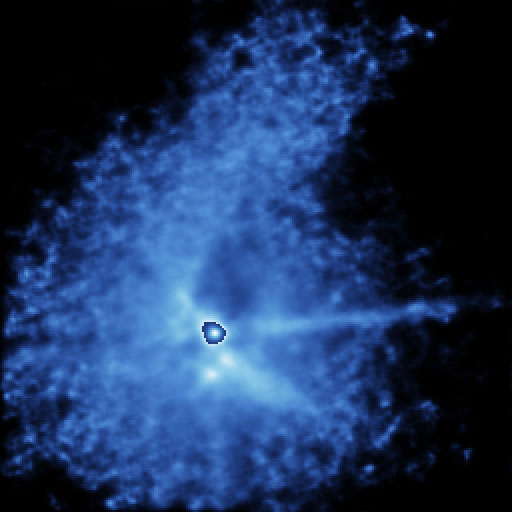
What did the Sun look like before there were planets? A prototype laboratory for the formation of low mass stars like our Sun is the T Tauri system, one of the brighter star systems toward the constellation of Taurus. In young systems, gravity causes a gas cloud to condense. The situation then usually becomes quite complex, as some of the infalling gas is heated so much by collisions that it is immediately expelled as an outgoing wind. Complex geometries including jets and disks form as the infalling and outflowing gas collide and interact with a changing magnetic field. Pictured above is a false-color image of the T Tauri system itself, which turns out to be a binary. In a few million years, the central condensate will likely become hot enough to ignite nuclear fusion, by which time much of the surrounding circumstellar material will either have fallen in or have been driven off by the stellar wind. At that time, a new star will shine.