The Sun
The Sun is a yellow dwarf star (G2V), about 4.6 billion years old, and the dominant gravitational force in the Solar System. It has a diameter of roughly 1.4 million kilometers and contains around 99.8% of the Solar System’s mass. Nuclear fusion in its core converts hydrogen into helium, producing energy that warms the planets. Above the core lie the radiative and convective zones, followed by the visible photosphere (~5,500 °C), the chromosphere, and the much hotter corona (~2 million °C).
Source: science.nasa.gov
APODs including "The Sun"
Diamond Ring in the Sun
21/06/2001
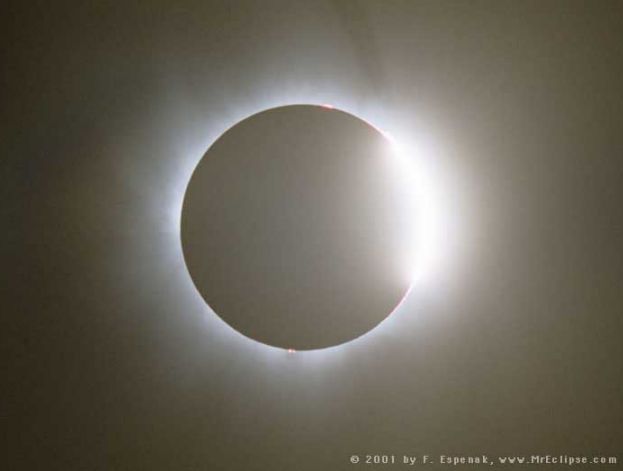
Today, earthbound skygazers can celebrate a solstice, a new Moon, the closest approach of planet Mars since 1988 ... oh yes, and a total eclipse of the Sun, the first total solar eclipse of the third millennium. Of course for some, today's most spectacular celestial views will be of the eclipsed Sun from along the path of totality as the new Moon's shadow tracks across southern Africa and Madagascar. This picture from the August 1999 total solar eclipse captures the shimmering solar corona just as that eclipse's total phase ended, as seen from eastern Turkey. The first rays of bright sunlight shinning through edge-on lunar mountains and valleys create the fleeting appearance of glistening diamonds set in a ring around the Moon's silhouette. Do you want to see today's solar eclipse? Eclipse expeditions are offering live webcasts.