The Sun
The Sun is a yellow dwarf star (G2V), about 4.6 billion years old, and the dominant gravitational force in the Solar System. It has a diameter of roughly 1.4 million kilometers and contains around 99.8% of the Solar System’s mass. Nuclear fusion in its core converts hydrogen into helium, producing energy that warms the planets. Above the core lie the radiative and convective zones, followed by the visible photosphere (~5,500 °C), the chromosphere, and the much hotter corona (~2 million °C).
Source: science.nasa.gov
APODs including "The Sun"
The Seasons of Saturn
02/07/2001
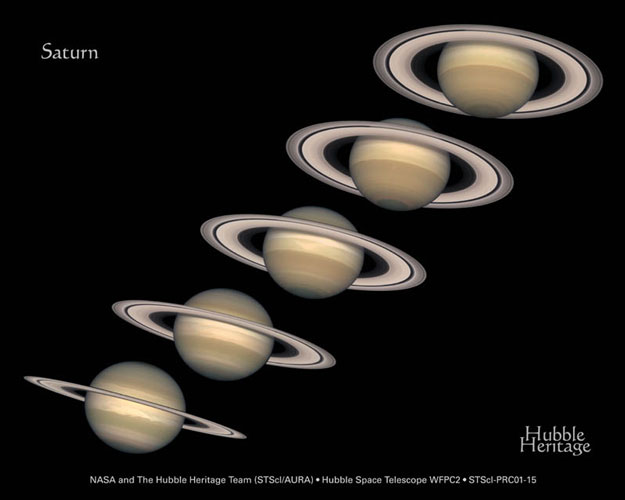
Soon it will be winter in Saturn's northern hemisphere. Since Saturn is tilted in its orbit around the Sun, it has seasons just like the Earth. When a hemisphere is tilted so that the Sun passes more directly overhead, summer occurs. Half an orbit later -- about 15 (Earth) years for Saturn -- winter occurs. Since the rings of Saturn orbit the equator, they provide a quite graphic seasonal display. The Hubble Space Telescope took the above sequence of images about a year apart, starting on the lower left in 1996. Saturn's rings are less than 50 meters thick and are composed of pebble and boulder sized chunks of dusty water ice.