The Sun
The Sun is a yellow dwarf star (G2V), about 4.6 billion years old, and the dominant gravitational force in the Solar System. It has a diameter of roughly 1.4 million kilometers and contains around 99.8% of the Solar System’s mass. Nuclear fusion in its core converts hydrogen into helium, producing energy that warms the planets. Above the core lie the radiative and convective zones, followed by the visible photosphere (~5,500 °C), the chromosphere, and the much hotter corona (~2 million °C).
Source: science.nasa.gov
APODs including "The Sun"
Pulsar Wind in the Vela Nebula
19/07/2001
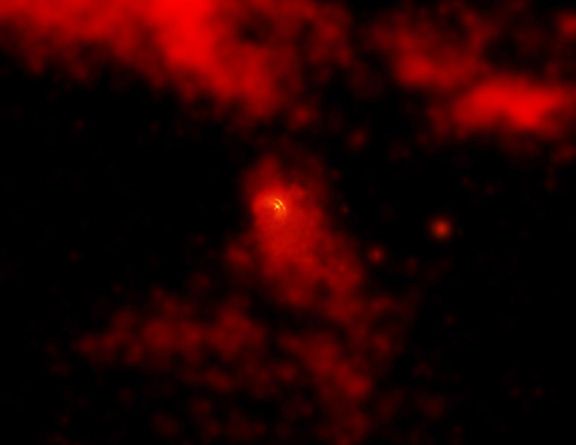
The Vela pulsar was born 10,000 years ago at the center of a supernova -- an exploding star. In this Chandra Observatory x-ray image, the pulsar still produces a glowing nebula at the heart of the expanding cloud of stellar debris. The pulsar itself is a neutron star, formed as the stellar core was compacted to nuclear densities. With a strong magnetic field, approximately the mass of the Sun, and a diameter of about 20 kilometers, the Vela pulsar rotates 11 times a second. The sharp Chandra image aids astronomers in understanding such extreme systems as efficient high-voltage generators which drive structured winds of electrically charged particles. An x-ray bright nebula is created as the pulsar winds slam into the surrounding material. This view spans about 6 light-years across the central region of the much larger Vela supernova remnant.