The Sun
The Sun is a yellow dwarf star (G2V), about 4.6 billion years old, and the dominant gravitational force in the Solar System. It has a diameter of roughly 1.4 million kilometers and contains around 99.8% of the Solar System’s mass. Nuclear fusion in its core converts hydrogen into helium, producing energy that warms the planets. Above the core lie the radiative and convective zones, followed by the visible photosphere (~5,500 °C), the chromosphere, and the much hotter corona (~2 million °C).
Source: science.nasa.gov
APODs including "The Sun"
Madagascar Totality
26/07/2001
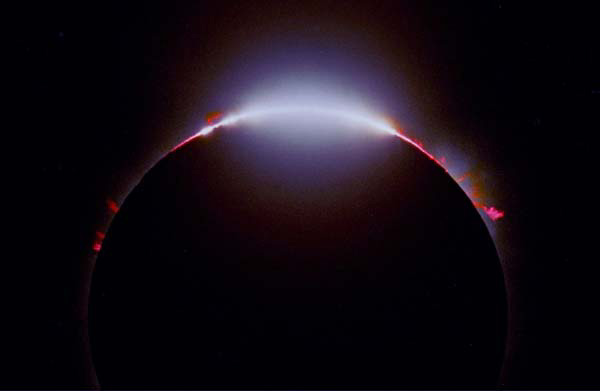
When the Moon's shadow reached out and touched Earth's southern hemisphere on 2001 June 21, the first total solar eclipse of the 21st century began. Starting in the Atlantic, the dark, central lunar shadow or umbra traced a path which crossed southern Africa and the large island of Madagascar before ending at sunset in the Indian Ocean. Of course, as the lunar disk blocked the Sun the total phase offered splendid views of the elusive outer solar corona. But, as seen in this stunning telescopic view from southern Madagascar, it also revealed an active solar limb bristling with pinkish, planet-sized prominences. Taken as totality began, this image of the last bright rays of sunlight shining through dips and valleys in irregular lunar terrain gives the illusion of a glittering jewel set in a pink celestial ring.